

Tips might be the messiest number in your entire salon. They come in through cash and card, they get split and shared, and they pass through a dozen hands before anyone writes them down. For years, tips were the thing owners handled loosely and hoped for the best with. As of 2025, that casual approach quietly got more expensive, and getting tips right at tax time can now put real money back in your pocket and your stylists' pockets too.
Two big changes arrived with the One Big Beautiful Bill Act, signed in July 2025: a new "No Tax on Tips" deduction for people who earn tips, and an expanded FICA Tip Credit that finally reaches salons. Both reward clean tip records and both punish sloppy ones. Here's how to handle tips at tax time without leaving money on the table or tripping a compliance wire.
Before the new perks, the basics. Tips are taxable income, and reporting them is not optional. Any employee who receives $20 or more in tips in a month is required to report that total to you, the employer, by the 10th of the following month, usually on Form 4070. You then include those reported tips on their W-2 (in Box 1 and Box 7, Social Security tips) and withhold and remit payroll taxes on them.
A few things worth underlining:
This is the change everyone has heard about, and it's widely misunderstood. "No Tax on Tips" is not a magic switch that makes tips tax-free. It is a deduction. For tax years 2025 through 2028, eligible workers can deduct up to $25,000 of qualified tips from their federal taxable income.
What counts:
Who can use it:
The limits: the deduction phases out once modified adjusted gross income exceeds $150,000 for single filers or $300,000 for joint filers, shrinking by $100 for every $1,000 above the line, and married workers must file jointly to claim it. Most salon professionals sit comfortably under those thresholds, so for your team this is usually a straight win, as long as their tips are on the record.
That "as long as" is the whole game. A stylist can only deduct tips that were actually reported. Sloppy tip tracking no longer just risks a penalty. It now costs your people a deduction they're entitled to.
Here's one that most salon owners haven't caught up to yet, and it can be worth real money. When your employees report tips, you pay the employer's 7.65% share of Social Security and Medicare on those tips. The FICA Tip Credit, found in Section 45B of the tax code, lets you claim that back as a dollar-for-dollar federal tax credit. Restaurants have used it since the 1990s. As of 2025, the One Big Beautiful Bill Act extended it to salons, barbershops, and spas, retroactive to January 1, 2025, so your 2025 return is the first one where you can claim it.
The basics for a salon:
To qualify, you generally need W-2 employees (not booth renters), tipping has to be customary in your business (in a salon, it is), your gross tips for the year should be at least 15% of your service revenue, and, crucially, your payroll has to track tips separately from wages. For a salon with a few tipped stylists, this credit can add up to thousands of dollars a year that you're otherwise handing to the government for no reason.
One catch worth naming: when you claim the credit, you reduce your wage expense deduction by the same amount. You can't count that money twice.
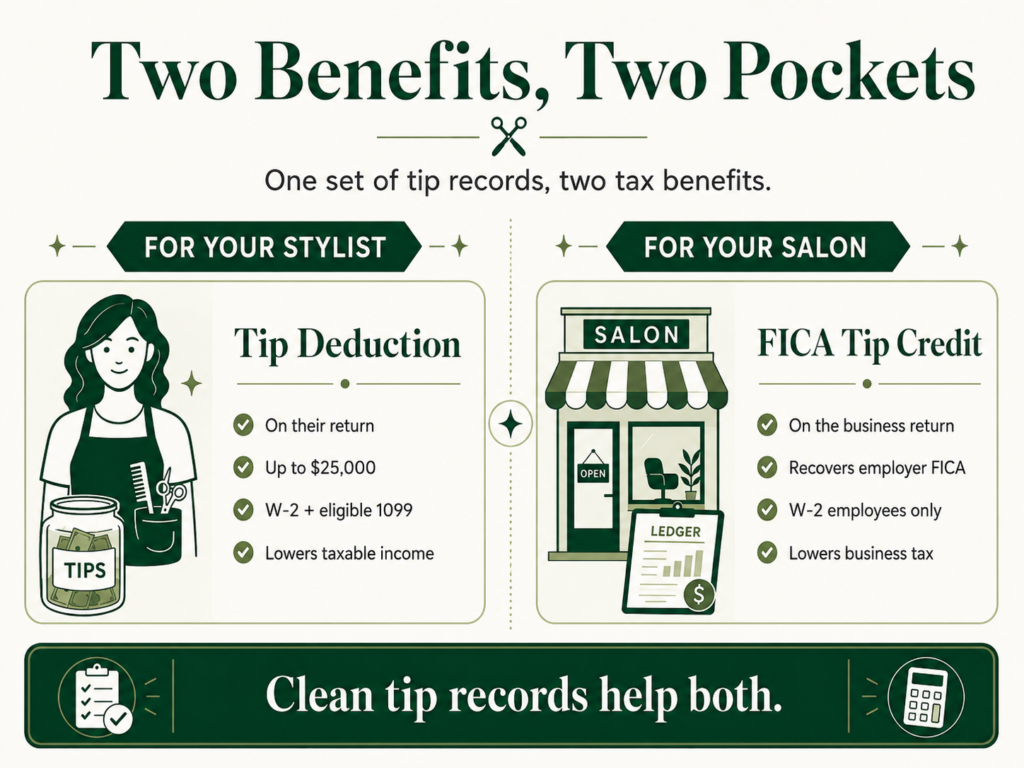
Because these two provisions arrived together and both involve tips, owners mix them up constantly. Keep them straight:
They are not either-or. A well-run salon captures both at once: your stylists get their deduction, and you get your credit, all from the same clean set of tip records.
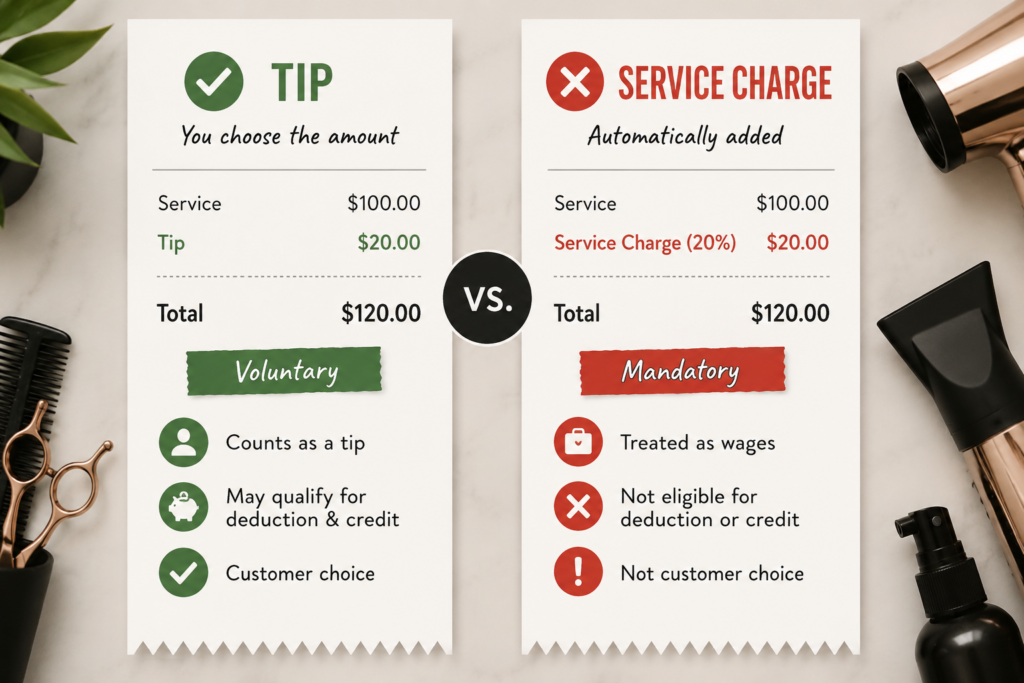
This is the single most common error, and it cuts both ways. If you add an automatic charge, say a set percentage for a bridal party or a large group, that money is a service charge, not a tip. Legally, it is treated as wages. It does not count toward your stylist's No Tax on Tips deduction, nor does it count toward your Form 8846 credit. If your books lump automatic charges in with voluntary tips, both benefits get distorted, and your records won't hold up. Voluntary tips and service charges need to live on separate lines.
For the 2025 tax year, the IRS granted transition relief: employers were not required to separately report qualified tips on W-2s, and workers could calculate the deduction from their own records. That grace period ends. Starting with the 2026 tax year, you'll have to report qualified tips separately on the W-2, with the amount in Box 12 and a Treasury "tipped occupation code" in Box 14b.
To be ready, your payroll needs to capture qualified tips separately from wages and from service charges, and each tipped role needs the correct occupation code. If your current setup pours everything into one bucket, that's a project to tackle before year-end, not during it.
The theme by now is obvious: every one of these benefits rests on clean tip records. In practice, that looks like:
This is exactly the kind of setup we build for salons. Done once, correctly, it runs quietly in the background and pays for itself.
Tips will always be a little messy. That's the nature of a salon. But messy records now cost you and your team real money, between a deduction your stylists can claim and a credit you can. Getting your tip tracking clean is one of the highest-return things you can do before tax season, and it's not complicated once it's set up right.
If you're not sure your tips are being captured in a way that holds up, or you want to make sure you're claiming the FICA Tip Credit you're owed, that's exactly what we do.